🩺 MarginNote · for medical students

Keep your textbooks where you can use them later.

What medical students and residents typically do with MarginNote: pull the same system's content from internal med, surgery, imaging, and pharm into one mind map; link question-bank misses back to the textbook paragraph; turn highlights into reviewable cards as you read. If you already use Anki, you don't have to switch — MN and Anki round-trip via apkg.

"I am currently in my medical residency, needing to cover multiple text books for each field of studying. With MarginNote, I load up multiple textbooks, can search all of them and make an outline and add notes and excerpts from all of those textbooks, all in one place."
— Tree Planter Nextdoor · Medical Resident · US App Store · 2020-09 · ★★★★★
First Aid Robbins BRS series Sketchy / Pixorize UWorld crosslinks
Anki users
start here
FSRS-native scheduling apkg in / apkg out AnKing keeps working Image occlusion built in

Below are the four things medical users typically do in MarginNote — each with a concrete example.

For where MN fits around Anki specifically, see vs Anki →

From textbook reading to flashcards, in one workflow.

01 · Card making

Highlight Robbins. The card is already there.

The cost of "self-made cards" drops to one motion: select on a PDF, the card is generated. Five highlight colors map to five card types. Cloze and image-occlusion both happen on the original page — no Anki plugin install required. Export to apkg whenever you want; AnKing decks can be brought in to layer alongside.

  • Five color-coded highlight types — definition, mechanism, clinical pearl, buzzword, image-occlusion.
  • Cloze directly on PDF — select a phrase, the back of the card is the original page.
  • Tag inheritance from book structure — system, chapter, sub-section already attached.
  • Bidirectional apkg — pull cards into Anki, or pull AnKing in to layer your own.
Robbins · Ch. 4 · Inflammation

Acute inflammation cardinal signs: rubor, tumor, calor, dolor, and functio laesa. Key mediator early phase: histamine from mast cells.

Five cardinal signs of acute inflammation?
auto-card · highlightdue in 3d
Key mediator of early-phase acute inflammation?
auto-card · highlightdue in 8d
02 · Multi-book scheduling

First Aid, Robbins, UWorld in one queue.

Add cards from multiple books once; MN schedules across all of them at the learning-plan level, weighing weak-spot tags, deadlines, and how recently you touched each chapter. When today's load is heavy, low-priority cards slide forward automatically instead of piling up as overdue.

  • Add-once → auto-schedule across books, no per-card priority needed.
  • Auto-postpone behavior — when today is too heavy, low-priority cards slide forward automatically rather than piling on as overdue.
  • Deadline-aware — Step 1 date drives proximity weighting in the final 8 weeks.
Today's queue · auto-prioritized across 4 sources
First Aid · Cardio · myocardial action potential phases
p=0.92 · weak spotdue now
UWorld block 14 · Renal · FeNa interpretation
p=0.88 · missed 3×due now
Robbins · Ch. 4 · histamine release sequence
p=0.61 · auto-postponed +2dtomorrow
BRS Phys · acid-base disturbance compensation
p=0.42 · light-trackin 12d
03 · Light-track recall (no SRS queue)

Some recall doesn't have to enter the queue.

Not everything you want to remember belongs in the SRS queue — tomorrow's quiz, an attending's pimping question, anatomy you'll see again next block. Putting them all in Anki just compounds daily review load. MN ships several light-track recall mechanisms that don't enter the FSRS queue and don't add to your daily count.

  • Mind-map node folding — collapse to title, recall the children, expand to verify.
  • Highlight blanking — toggle highlights to invisible for self-test, snap back on tap.
  • Rectangle & highlighter occlusion with recall mode — useful for diagrams without making image-occlusion cards.
  • Handwriting layer hide/show — write what you remember, reveal what you wrote earlier.
Why this matters specifically for med school. A typical USMLE Step 1 deck reaches 10,000+ mature cards by dedicated. Even a small percentage that don't actually need long-term spacing — anatomy you'll see again next block, tomorrow's quiz, an attending's pimping question — compounds into hours of daily review. Light-track recall is where they go.
Endocrine · light-track self-test
► Hypothalamus (tap to expand · 4 children)
► Pituitary (tap to expand · 6 children · folded since 2 hr ago)
▼ Adrenal cortex
— glomerulosa: aldosterone
— fasciculata: cortisol
— reticularis: DHEA
↳ no card scheduled · no SRS impact · 0 added to today's queue
04 · Cards stay attached to source

Cards live on a four-level ladder.

Reviewing a card alongside its surrounding chunk usually recalls more than reviewing it in isolation. MN keeps every card linked to book → chapter → mind-map node → source paragraph. During review you can stay zoomed-in on the card, or zoom out to the surrounding context that originally encoded it.

  • One-tap source preview — see the original paragraph without leaving review.
  • Block review — define a third-level mind-map branch as a single review unit; the whole branch is one item, not eight cards.
  • Tag-bound chunks — review a tag (e.g. #renal #weak) as a single contextualized session.
Card under review · with 4-level chain visible
BOOK Robbins, Pathologic Basis of Disease, 11ed
CH Ch. 4 · Hemodynamic Disorders
NODE Mind-map: Edema → mechanisms
PARA p. 122, ¶3
Three mechanisms of edema?

Real Use · Not a Demo

What an actual medical student's work looks like.

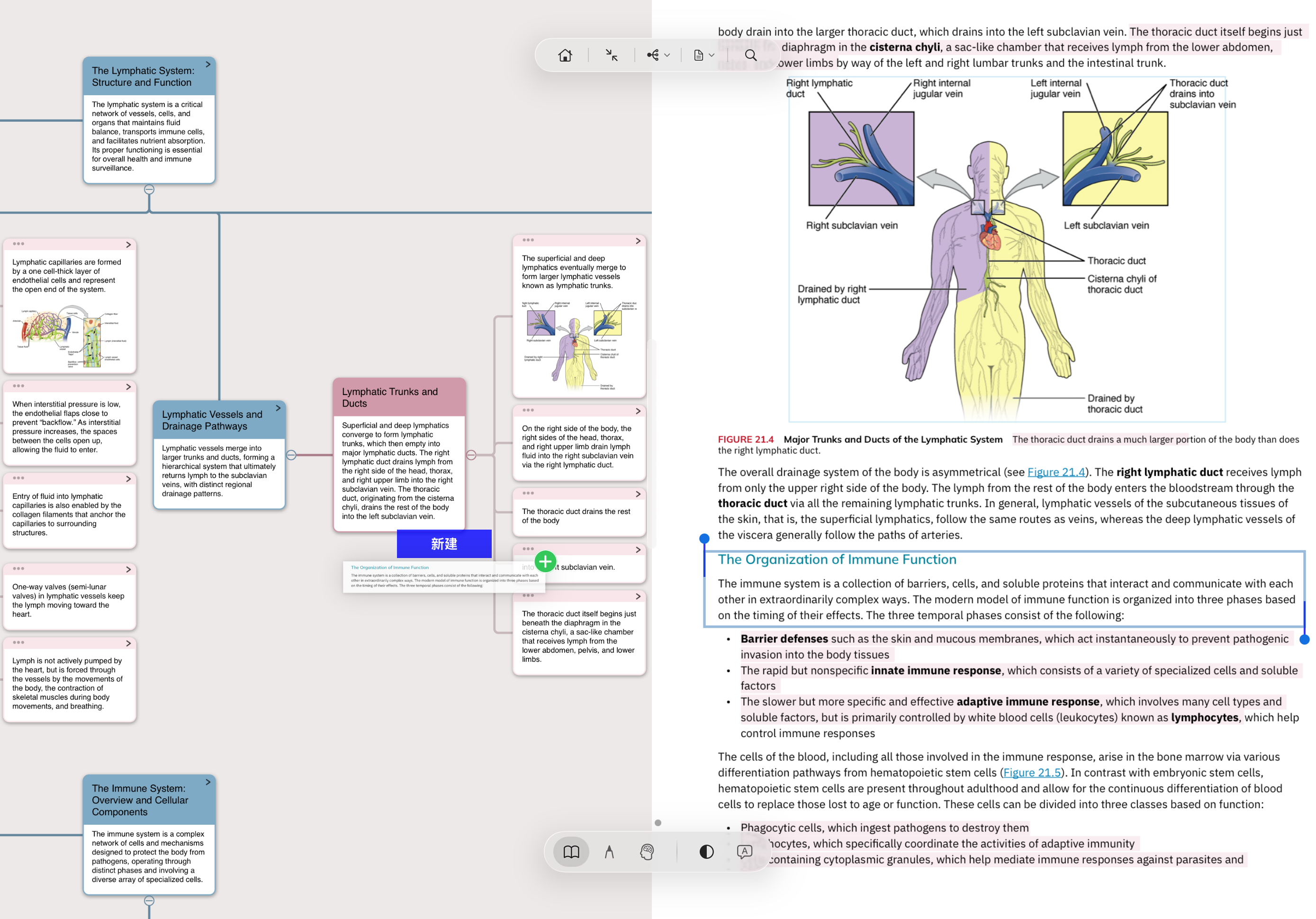
MarginNote real screenshot: lymphatic-system mind-map cards on the left, Robbins pathology PDF on the right with highlighted terms (barrier defenses / adaptive immune response with blue markers); the highlights are what generated the cards on the left
Highlight Robbins → cards auto-generated on the left (immune / lymphatic system)
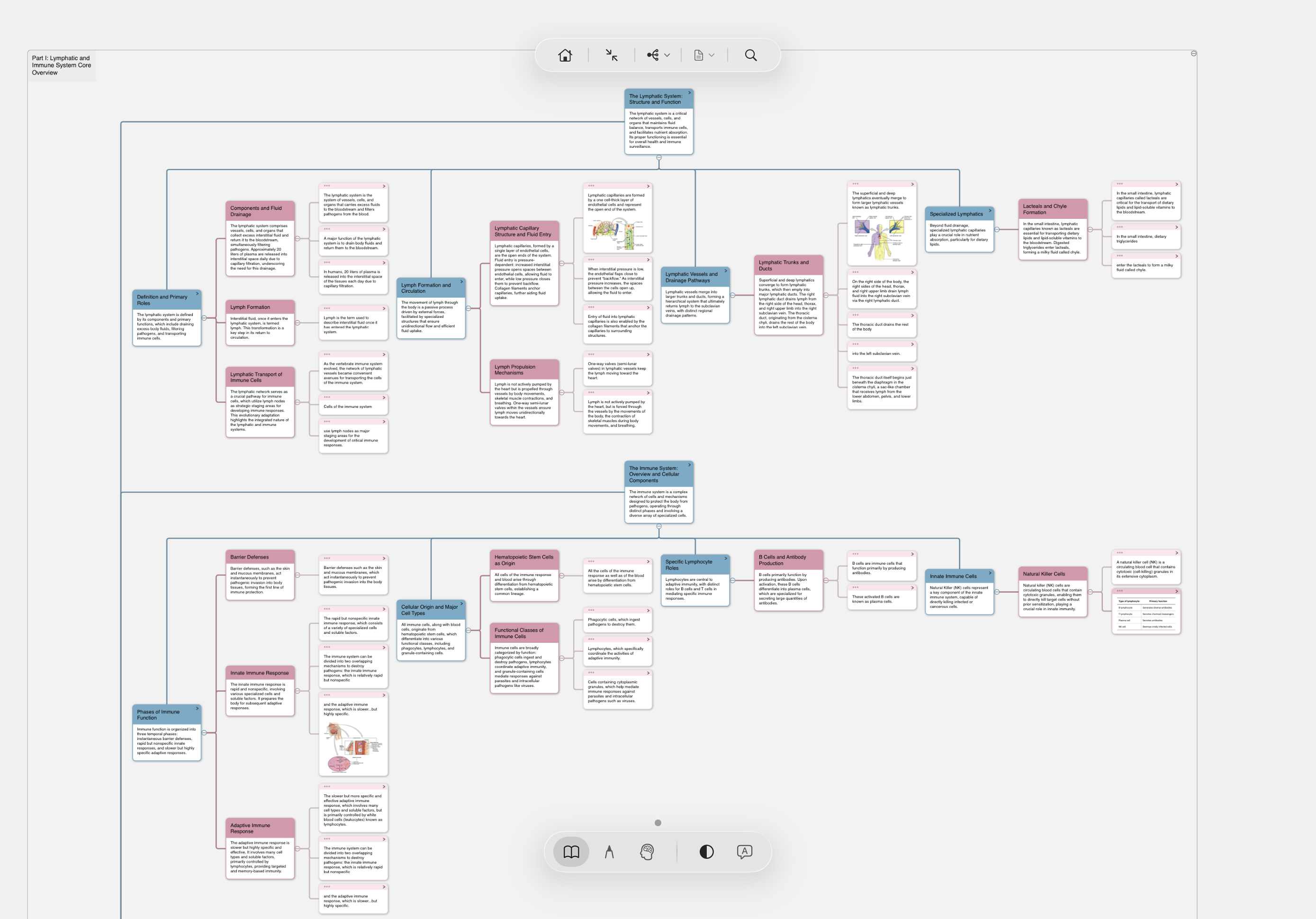
MarginNote real screenshot: the full 'Lymphatic and Immune System Core Concepts' mind map expanded, 30+ nodes across multiple levels covering lymphatic anatomy / drainage / immune organs / adaptive immunity
The same study set viewed as a full mind map (30+ nodes, multi-level)

Real screenshots from a Fudan medical student's lymphatic / immune system study set — this is what MN looks like after 4 years of clinical rotation study, not a marketing demo.

A physician on what changed.

"Throughout medical school and residency I was constantly looking for a program that let me upload electronic textbooks to highlight and annotate with easy referencing. I tried everything, Goodnotes, Onenote, Evernote - you name it I tried it, and while they all worked fine/ok for annotation and highlighting, they all struggled when it came to reviewing what I'd already gone over. Once I found MarginNote I was hooked."

J
JMayYXE · ★★★★★
Physician · Canadian App Store · Apr 14, 2022
Verbatim from App Store review titled "Best Note Taking Software Period - Physician Approved!" · MarginNote 3 (Mac) · review_id 280893313767LEKQwcqOb0XOzuW__JyTczA

What med students ask before switching.

Should I abandon AnKing?
No, and we don't want you to. AnKing is the result of a decade of crowdsourced refinement on one specific problem — Wozniak's "scheduling" layer. MarginNote handles the layers around it: getting cards out of textbook reading without retyping, holding multi-book priority, and giving lighter material a non-SRS recall path. Most med-student users we've heard from run both. Export from MarginNote in apkg, layer alongside your AnKing deck.
Is FSRS in MarginNote the same as in Anki?
Same algorithm family — FSRS is open-source and benchmarked publicly by Jarrett Ye and the open-spaced-repetition project on a corpus of 1.7 billion reviews from ~20,000 Anki users (paper accepted at ACM SIGKDD). MarginNote ships FSRS as the default scheduler. Your existing FSRS-tuned parameters from Anki are not portable, but the behavior and predictions are equivalent.
Doesn't FSRS already solve "ease hell" / pile-up?
FSRS solves the algorithmic side of pile-up — the part where SM-2 over-penalized lapses and made intervals collapse. It does not solve the structural side: when 30% of your "must remember" items don't actually need long-term spacing, you've still over-loaded your queue regardless of algorithm. Light-track recall (Gap 3) is the structural fix — reserving the SRS queue for items that genuinely need long-term spacing.
Image occlusion for Netter plates — same as the Anki add-on?
Same mechanics: rectangles you draw, revealed one at a time. Built in, not a plugin. Round-trips to Anki via apkg work for most cases; very complex Anki occlusion templates may need testing first.
Can I use it on iPad during a lecture?
Yes — Apple Pencil handwritten annotations on the lecture PDF are searchable. Most users do reading and card-creation on Mac, light-track review on iPad in coffee-shop mode.
Does MarginNote have a Step 1 community deck?
No, and we don't think we should compete with AnKing on that. AnKing is the right tool for "comprehensive shared deck I can grind." MarginNote is the right tool for "the chapter I'm reading right now turning into my own cards as I read it." The two roles don't overlap.
Read the textbook.
Let the textbook schedule itself.

Free 14-day trial. macOS and iPadOS. FSRS-native. apkg in/out. Your AnKing deck still works.